Building Predictive AI Agents with MCP Architecture That Actually Works
2026-05-04 • Predictive-AI,AI,MCP,AWS • Sam Madireddy
Most agents optimize prompts, LLMs, and tool chains but ignore the layer that drives decisions: prediction.
This is why most ML models never leave notebooks or dashboards. They were never designed to be consumed by decision systems.
An agent without prediction is just automation. An agent with prediction is a decision engine.
In this article we'll walk through how MCP changes the game, not just as a tool protocol, but as the enabling architecture for agents that predict and act on those predictions.
👉 Why prediction and reasoning have been disconnected — until now
👉 What MCP actually does in a predictive agent system
👉 A real demand forecasting agent, end to end
👉 AWS and Python implementation patterns
👉 The architecture decisions that make or break it
1. Why Prediction and Reasoning Have Been Disconnected
For years, ML teams have built incredible predictive models — demand forecasts, churn scores, anomaly detectors. And separately, software teams have built agents and automation workflows. The two rarely talked to each other cleanly.
The problem wasn't capability. It was plumbing.
Every team that wanted an agent to consume a prediction had to build a custom integration: a REST wrapper here, a Lambda function there, a bespoke API schema that no other system understood. When you had five prediction models and three agents, you ended up with fifteen custom connectors. Each one brittle, each one different.
This is why most ML models never leave notebooks or dashboards. They were never designed to be consumed by decision systems.
🎯 Why this matters for tech leaders: Your ML investments are likely sitting idle because there's no standard way for your agents to consume them. MCP is what changes that — it turns prediction models into first-class, reusable tools that any agent can call in a uniform way.
2. What MCP Actually Does in a Predictive Agent System
MCP, the Model Context Protocol defines a standard interface that agents use to call external tools and data sources. Think of it as the USB standard for AI: instead of every device needing a different cable, every tool speaks the same protocol.
In a predictive agent system, this means:
- A demand forecasting model on SageMaker becomes an MCP server
- A customer segmentation model exposed via service (like Bedrock, Lambda, or a custom endpoint) becomes an MCP server
- An inventory system or CRM becomes an MCP server
The agent doesn't know or care what's behind each server. It calls them all through the same MCP interface, gets back structured predictions, reasons over those predictions together, and then decides what to do.
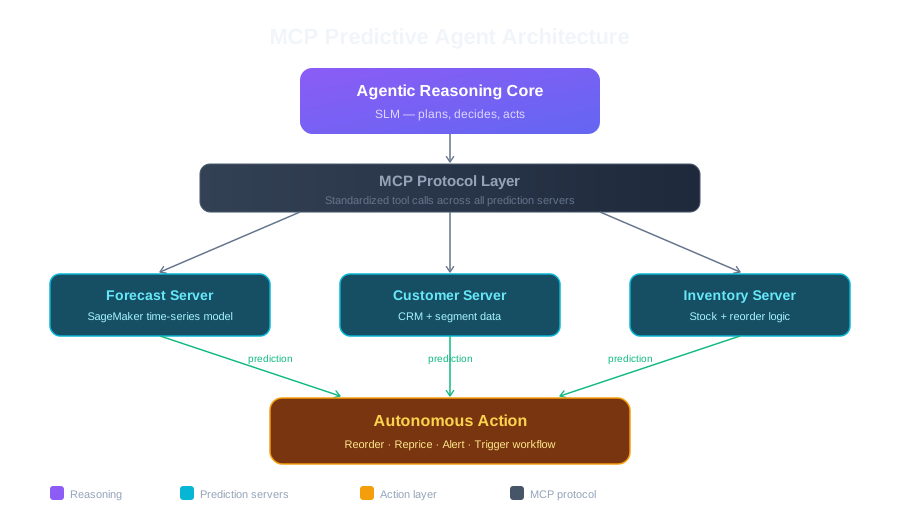
🎯 Why this matters for tech leaders: MCP means your engineering teams stop building one-off integrations and start building reusable prediction servers. A forecast model built once can be called by any agent across your organization - today and in the future.
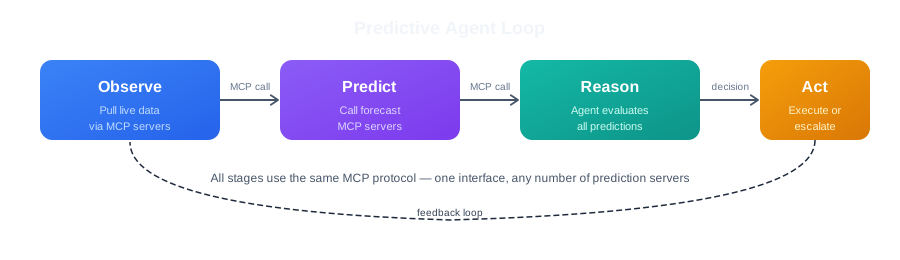
3. The Three-Stage Flow: Observe, Predict, Act
Every predictive agent follows this pattern regardless of domain.
Observe : The agent calls MCP servers to pull current state: inventory levels, recent sales velocity, customer signals, market conditions.
Predict : The agent calls one or more prediction MCP servers and gets back structured forecasts with confidence scores.
Act : The agent reasons over all predictions together and decides: reorder stock, trigger a pricing change, escalate to a human, or do nothing.
The key insight is that MCP makes all three stages use the same protocol. The agent doesn't need three different integration patterns, it has one.
4. Real Example: The Demand Forecasting Agent
Let's make this concrete. Here's a demand forecasting agent that calls three MCP servers, reasons over the combined predictions, and decides whether to trigger a reorder.
4.1 The MCP Forecast Server (Python + SageMaker)
This is the server your SageMaker model sits behind. Any agent that speaks MCP can call it.
import boto3
import json
from mcp.server import MCPServer, tool

app = MCPServer("demand-forecast")
sagemaker = boto3.client("sagemaker-runtime", region_name="us-east-1")

@tool(description="Forecast demand for a SKU over the next N days")
def forecast_demand(sku_id: str, horizon_days: int = 7) -> dict:
    payload = {"sku_id": sku_id, "horizon_days": horizon_days}
    response = sagemaker.invoke_endpoint(
        EndpointName="demand-forecast-endpoint",
        ContentType="application/json",
        Body=json.dumps(payload)
    )
    result = json.loads(response["Body"].read())
    return {
        "sku_id": sku_id,
        "forecast": result["predictions"],
        "confidence": result["confidence"]
    }

if __name__ == "__main__":
    app.run()
4.2 The Agent That Reasons Over Predictions
from mcp.client import MCPClient

forecast_server  = MCPClient("http://forecast-mcp:8000")
inventory_server = MCPClient("http://inventory-mcp:8001")
customer_server  = MCPClient("http://customer-mcp:8002")

def run_demand_agent(sku_id: str):
    forecast      = forecast_server.call("forecast_demand",
                        sku_id=sku_id, horizon_days=7)
    inventory     = inventory_server.call("get_stock_level", sku_id=sku_id)
    demand_signal = customer_server.call("get_demand_signal", sku_id=sku_id)

    projected_demand = sum(forecast["forecast"])
    current_stock    = inventory["units_on_hand"]
    coverage_days    = current_stock / (projected_demand / 7)

    if coverage_days < 3 and demand_signal["trend"] == "rising":
        reorder_qty = int(projected_demand * 1.2 - current_stock)
        inventory_server.call("trigger_reorder",
            sku_id=sku_id, quantity=reorder_qty)
        return f"Reorder triggered: {reorder_qty} units for {sku_id}"

    return f"No action needed. Coverage: {coverage_days:.1f} days"
Key point: Every system is accessed through the same interface. Forecast, inventory, and customer data all come through identical MCP calls. Add a fourth server tomorrow: pricing, weather, logistics. And the agent logic doesn't change at all.
5. Production AWS Architecture for MCP Predictive Agents
Designing this on AWS follows three clear paths, each independently scalable.
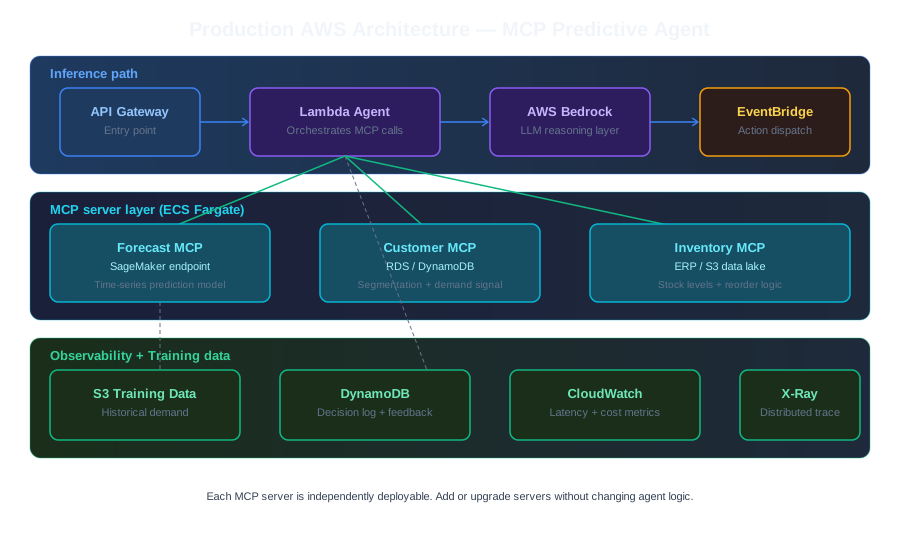
Inference path : API Gateway receives the trigger (scheduled, event-driven, or user-initiated). Lambda hosts the agent orchestrator, which calls MCP servers, reasons over results, and invokes Bedrock for higher-level reasoning when needed. Actions are dispatched via EventBridge.
MCP server layer : Each prediction capability is its own ECS Fargate service. The Forecast MCP wraps your SageMaker endpoint. The Customer MCP wraps RDS or DynamoDB. The Inventory MCP wraps your ERP or S3 data lake. Each is independently deployable and scalable.
Observability and training data : Every agent decision logs to DynamoDB. Latency and cost stream into CloudWatch. X-Ray traces the full decision path. Historical demand lives in S3 to retrain the SageMaker model as conditions shift.
🎯 Why this matters for tech leaders: Every component is independently scalable. Upgrade your forecast model without touching the agent. Add a new MCP server — pricing, weather, logistics, without changing the architecture. That composability is what MCP gives you.
6. A Note on Small Language Models
This architecture is not tied to large, expensive LLMs. Because MCP standardizes the interface between prediction servers and the reasoning layer, you can run the agent on a smaller, locally-deployed model — Phi, Mistral, or similar — and the prediction servers remain unchanged. For teams with latency constraints, cost sensitivity, or data residency requirements, that matters. This will be explored in depth in a future post.
7. What Makes or Breaks a Predictive Agent
When you look at this architecture through both a technical and strategic lens, a few priorities stand out:
Prediction quality beats agent sophistication. If your SageMaker model is poorly trained, no amount of clever agent reasoning fixes a bad forecast. Invest in model quality first.
Schema design is a first-class concern. Your MCP servers need well-designed response schemas — confidence intervals, metadata, timestamps. A forecast without a confidence score is a liability for an autonomous agent.
Observability is not optional. Track every decision the agent makes, what predictions it consumed, and what action it took. Log to DynamoDB from day one.
Start with one MCP server, one action. Pick one prediction, one action, one feedback loop. Expand from there.
Treat the agent as a product. Version your MCP servers. Build evaluation sets. Define what good decisions look like before you deploy.
8. Putting It All Together
def predictive_agent_loop(sku_id: str) -> dict:
    stock    = inventory_server.call("get_stock_level", sku_id=sku_id)
    signal   = customer_server.call("get_demand_signal", sku_id=sku_id)
    forecast = forecast_server.call("forecast_demand",
                   sku_id=sku_id, horizon_days=7)

    coverage = stock["units_on_hand"] / (sum(forecast["forecast"]) / 7)

    if coverage < 3 and forecast["confidence"] > 0.80:
        qty = int(sum(forecast["forecast"]) * 1.2 - stock["units_on_hand"])
        inventory_server.call("trigger_reorder", sku_id=sku_id, quantity=qty)
        return {"action": "reorder", "quantity": qty, "coverage_days": coverage}

    return {"action": "none", "coverage_days": coverage}
MCP doesn't just standardize tool calls. It standardizes how intelligence flows through a system — from data to prediction to action. That layer is what agents have been missing.
When it's in place, agents stop being reactive scripts and start becoming decision engines.
The agents that will define the next decade aren't the ones with the best prompts — they're the ones built on the right architecture.
MCP isn't an implementation detail. It's a strategic decision. It's the difference between shipping an AI feature and building an AI system that learns, predicts, and scales with your business.
The teams winning with AI right now aren't chasing the latest model release. They're investing in the infrastructure layer that makes every model smarter — the context pipeline, the prediction loop, the decision engine underneath.
That's what MCP gives you.
If you're leading a team that's serious about moving from AI experimentation to AI execution, this is the layer worth getting right.
If you'd like to bounce ideas about MCP, predictive agents, or AWS architecture, feel free to reach out.
Sam Madireddy
Contact me on LinkedIn